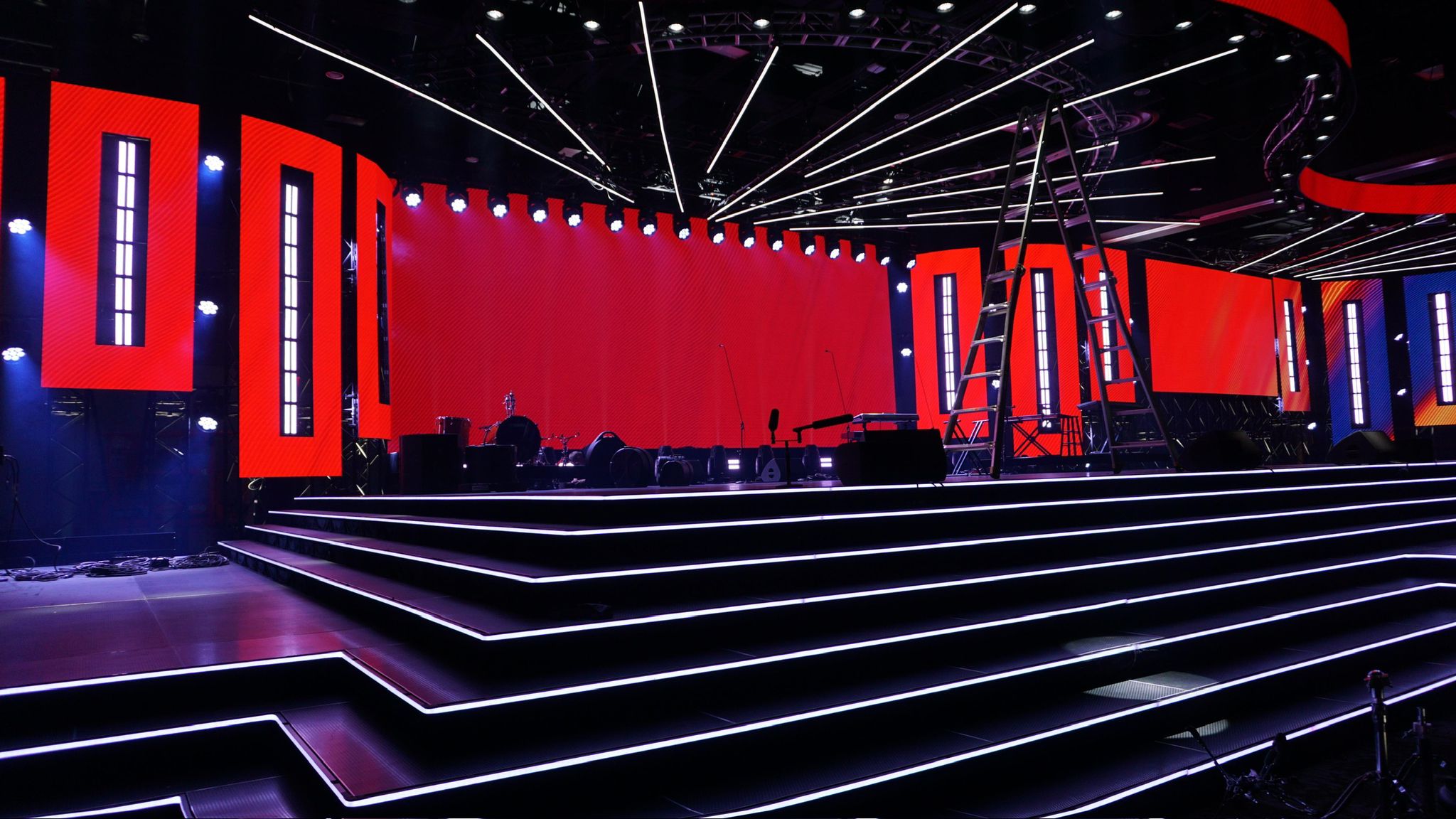

The choice between LED video walls and projection systems fundamentally impacts concert production aesthetics, logistics, and economics. Understanding each technology’s strengths, limitations, and optimal applications enables informed decisions aligning with artistic vision, venue constraints, and budget realities.
Brightness and Ambient Light Performance
LED displays achieve 4,000-6,000 nits brightness, maintaining visibility under full stage lighting and outdoor daylight. This brightness enables simultaneous use with theatrical lighting without washing out images. A 5,000-nit LED wall remains clearly visible even with 100,000 lumens of stage lighting directed nearby. Automatic brightness adjustment responds to ambient conditions, optimizing visibility while preventing eye strain.
Projection systems typically produce 20,000-40,000 lumens for concert applications, translating to 200-400 nits on typical screen surfaces. This brightness proves adequate for controlled lighting environments but struggles when competing with stage lighting. Projections require dimmed house lights and careful lighting design avoiding screen spill. Outdoor daylight completely washes out projected images, limiting projection to indoor or nighttime applications.
High Dynamic Range capabilities differ significantly between technologies. LED panels achieve 10,000:1 contrast ratios with true blacks through pixel-level dimming. Individual LEDs turn completely off for black content, creating infinite contrast. Modern LED processing supports HDR10 and Dolby Vision standards, displaying enhanced brightness ranges matching current content creation standards.
Projection contrast ratios typically reach 2,000:1 to 5,000:1 using laser phosphor sources. Black levels depend on ambient light control, as projectors cannot create blacks darker than surrounding environments. Dynamic iris systems improve perceived contrast but introduce pumping artifacts during scene transitions. Laser projection achieves better blacks than lamp-based systems but cannot match LED’s pixel-level control.
Resolution and Image Quality
LED resolution depends on pixel pitch and display area. A 150-square-meter display using 2.6mm pitch provides 4K resolution, while 3.9mm pitch delivers 2.5K resolution. Higher resolutions require tighter pixel pitches, increasing costs exponentially. Mini-LED technology promises 0.9mm pitches enabling 8K resolution on reasonably sized displays, though costs remain prohibitive for most applications.
Projection resolution independent of screen size makes it advantageous for ultra-high-resolution requirements. Native 4K projectors cost $30,000-80,000, with 8K models reaching $150,000. Multiple projectors edge-blended create even higher resolutions. A four-projector array delivers 8K resolution at any screen size, limited only by lens quality and throw distance.
Color gamut comparisons favor LED technology. Modern LED panels achieve 95% of DCI-P3 color space, with some reaching full Rec. 2020 coverage. Calibration maintains color accuracy across thousands of operating hours. Individual LED binning during manufacturing ensures color consistency across panels.
Laser projection systems achieve 80-90% of DCI-P3 color space, adequate for most content but limiting for wide-gamut material. Three-chip DLP projectors provide superior color accuracy compared to single-chip solutions. Color degradation over time requires periodic recalibration, particularly for lamp-based systems losing 50% brightness over 2,000 hours.
Setup Time and Logistics
LED wall assembly requires 6-12 hours for a 150-square-meter display including rigging, cabling, and calibration. Modular panel construction enables parallel assembly by multiple crew teams. Pre-configured touring frames reduce setup time to 4-6 hours for experienced crews. However, physical assembly remains labor-intensive regardless of experience.
Projection setup completes in 2-4 hours for comparable coverage areas. Projector positioning, lens alignment, and warping adjustment represent primary tasks. Automated calibration systems reduce manual adjustment requirements. Single projector setups require minimal crew, though multi-projector arrays demand specialized technicians.
Transportation requirements strongly favor projection systems. Four 30,000-lumen projectors fit in two flight cases weighing 200 kilograms each. Equivalent LED coverage requires 40-50 flight cases weighing 5,000-6,000 kilograms total. This 10-fold weight difference dramatically impacts transportation costs, particularly for fly-in dates or international tours.
Venue adaptability varies between technologies. LED walls require substantial floor or rigging support, potentially limiting placement options. Standard configurations may not fit unusual venue geometries. Projection adapts to any surface through geometric correction, enabling creative mapping onto architectural features. However, projection requires clear sight lines often conflicting with audience seating or production elements.
Reliability and Redundancy
LED systems demonstrate exceptional reliability through distributed architecture. Individual LED or driver failures produce minimal visual impact on large displays. Panels include redundant power supplies and control circuits. System-level redundancy involves spare panels and processing chains. Mean time between failures exceeds 50,000 hours for quality panels.
Projection systems represent single points of failure requiring complete redundancy. Lamp failures occur every 2,000-4,000 hours, demanding spare lamps and hot-swap procedures. Laser light engines extend operational life to 20,000 hours but cost significantly more. Backup projectors on automatic changers provide seamless failover but double equipment requirements.
Maintenance requirements differ substantially. LED panels need periodic cleaning and dead pixel replacement. Technicians can perform most maintenance during normal operations. Annual factory service maintains optimal performance. Total maintenance costs average 3-5% of system value annually.
Projector maintenance includes regular filter cleaning, lens adjustment, and alignment verification. Lamp replacements cost $1,000-3,000 occurring multiple times per tour. Professional cleaning and calibration require specialized facilities. Annual maintenance costs reach 10-15% of equipment value for lamp-based systems.
Creative Possibilities
LED walls enable creative configurations impossible with projection. Curved surfaces, transparent panels, and floor integration create immersive environments. Panels can form geometric shapes, spell words, or create architectural elements. The physical presence of LED surfaces becomes part of stage design rather than merely displaying content.
Projection mapping transforms entire venues into canvases. Building facades, stage sculptures, and even performers become projection surfaces. Real-time tracking enables projections following moving objects. However, these applications require extensive pre-production and precise calibration.
Interactive capabilities integrate naturally with LED systems. Touch-sensitive overlays, motion sensors, and camera tracking create responsive environments. Low latency enables real-time interaction without perceptible delay. Audience participation through mobile devices displays on LED walls instantaneously.
3D effects achieve different results with each technology. LED walls use forced perspective and content design creating depth illusions. Volumetric LED displays with panels at multiple depths provide true three-dimensional imagery. Projection enables glasses-free 3D through specialized screens and multi-view content, though viewing angles remain limited.
Economic Analysis
Initial investment for LED systems ranges from $500,000 to $2,000,000 for tour-ready packages. This includes panels, processing, rigging, and cases. Depreciation occurs over 5-7 years with 20-30% residual value. Financing options include leasing at 2-3% monthly rates.
Projection systems cost $150,000-500,000 for comparable visual impact. This includes projectors, lenses, screens, and processing. Faster depreciation over 3-5 years reflects rapid technological advancement. Lower initial investment enables more frequent upgrades.
Operational costs favor LED technology for heavy touring schedules. Lower maintenance requirements, longer lifespan, and reduced crew needs offset higher initial investment. Break-even typically occurs after 150-200 show days compared to projection rental rates.
Rental market availability affects technology choice. LED equipment commands $500-1,500 per square meter daily. Projection systems rent for $2,000-5,000 per projector daily. Regional availability varies, with LED more common in major markets while projection remains accessible globally.
The choice between LED and projection technologies depends on specific production requirements, touring patterns, and creative vision. LED excels in brightness, reliability, and creative configuration possibilities, justifying higher costs for premium productions. Projection offers resolution flexibility, setup speed, and projection mapping capabilities at lower initial investment. Many productions combine both technologies, leveraging respective strengths for maximum impact. As LED costs decrease and projection brightness increases, the distinction may blur, but fundamental differences in approach and application will likely persist.
