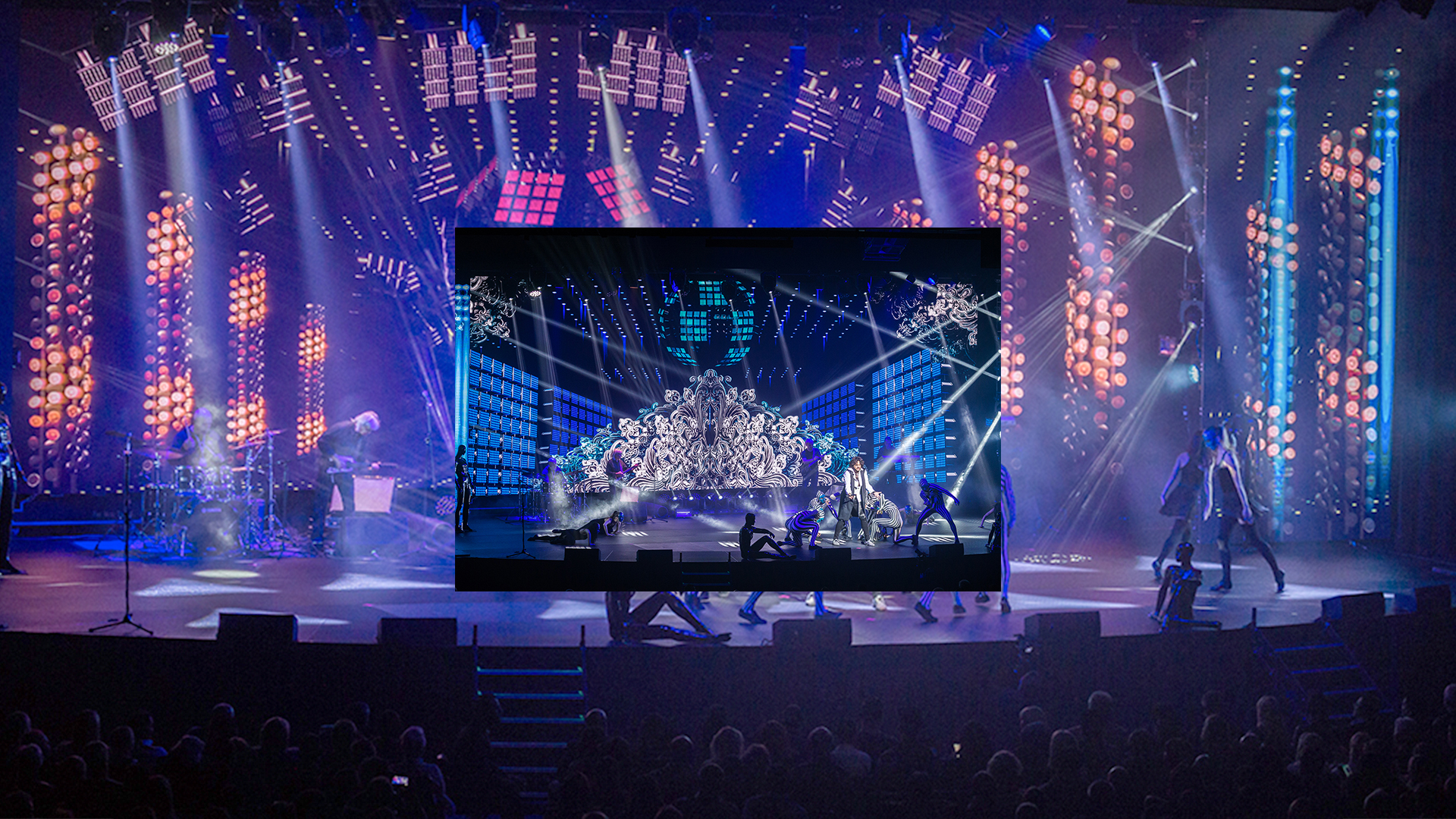
The trade show floor has evolved into visual warfare, where attention spans measured in seconds determine whether booth traffic converts into business opportunities. Among the innovations reshaping exhibit design, seamless LED corner technology represents a quantum leap in environmental branding capability. Where traditional booths stopped at walls and angles, modern installations wrap continuous imagery around corners, creating immersive brand environments that pull attendees from crowded aisles into carefully orchestrated experiences.
The Technical Evolution From Flat to Wrapped
Early LED implementations in trade show environments simply replaced traditional graphics with digital flat panels—expensive substitutions that offered animation capability without fundamentally changing booth architecture. The breakthrough came when manufacturers developed corner modules that maintain pixel continuity around 90-degree transitions. Content flows seamlessly from front-facing surfaces around corners to adjacent walls, eliminating the visual dead zones that once fragmented booth experiences.
ROE Visual Carbon series pioneered accessible corner solutions for exhibition applications, offering concave and convex corner modules that integrate with standard flat panels at multiple pixel pitches. The Absen Polaris series followed with corner options specifically designed for rental and staging applications where rapid assembly matters as much as visual performance. These products transformed what was previously custom fabrication requiring weeks of preparation into standardized components deployable within typical trade show load-in windows.
Pixel Pitch Selection for Exhibition Distances
Trade show viewing distances differ fundamentally from concert or broadcast applications, demanding pixel pitch selections that many production companies initially miscalculate. Attendees approach booths closely—often within two meters—making pixel structure visible on coarser pitch products that perform adequately at stage distances. The minimum pitch achieving invisible pixelation at arm’s length sits around 2.5mm, with premium installations dropping to 1.9mm or finer.
The Leyard TWA series at 1.2mm pitch delivers reference-quality imagery suitable for close inspection of detailed product photography or fine typography. For most trade show applications, INFiLED ER series at 2.6mm pitch provides the optimal balance between visual quality and budget efficiency. Content designers must understand these constraints—text sizing, line weights, and graphic detail requirements all derive from the pixel pitch specified during booth planning phases.
Structural Engineering for Portable Installations
Trade shows impose brutal logistical demands: installations that toured between venues must assemble quickly, survive transport stresses, and reconfigure for varying booth configurations. Support structures for corner LED installations must balance rigidity—essential for maintaining panel alignment—against portability and setup speed.
Modular framing systems from beMatrix and Aluvision have emerged as industry standards for LED-compatible booth structures. These aluminum extrusion systems provide the dimensional precision LED panels require while enabling tool-free assembly that union labor can execute efficiently. Corner installations demand additional engineering attention—the structural loads concentrate at bend points, requiring reinforced connections and carefully calculated ballast to prevent tipping without excessive floor weight.
Content Mapping for Continuous Surfaces
Creating content that flows naturally around corners requires specialized content mapping approaches distinct from flat-surface design. Standard motion graphics designed for rectangular canvases distort awkwardly at corners, with perspective cues conflicting as content transitions between planes. Effective corner content either embraces the geometry—using the corner as a compositional element—or employs abstract motion that survives angular transitions without perceptual disruption.
Media servers handle the technical content distribution. Disguise gx 2c systems excel at corner mapping, projecting virtual canvases onto physical geometries that media servers translate into correct output feeds for each panel section. Resolume Arena offers more accessible corner mapping for productions with smaller technical budgets, though its capabilities require more manual configuration than disguise’s automated workflows.
Historical Context: From Las Vegas to Global Exhibition
The transformation of trade show visual technology mirrors broader industry evolution. Las Vegas conventions during the 1980s featured backlit transparencies and mechanical rotating displays that seem prehistoric today. The 1990s brought early projection technology—bulky CRT projectors requiring dedicated dark environments. Plasma displays appeared around 2000, offering the first truly flat digital options, though their weight and fragility limited exhibition applications.
LED technology entered trade shows around 2010, initially as accent elements due to coarse pixel pitches unsuitable for close viewing. The CES 2015 Samsung booth marked an inflection point, demonstrating that massive LED installations could function as complete booth environments rather than isolated display elements. Since then, every major industry exhibition has witnessed escalating LED adoption, with corner technology representing the current frontier of immersive installation capability.
Processing Architecture for Multi-Surface Installations
Corner LED installations multiply video processing complexity beyond what single-surface deployments require. Each wall section feeds from processors receiving mapped content slices that must align precisely at corner transitions. Frame synchronization between processors prevents visible tearing where surfaces meet. Color calibration must maintain consistency across panels viewing from multiple angles under varying exhibition hall lighting.
Brompton Technology Tessera SX40 processors have become the reference standard for exhibition LED deployments. Their Dynamic Calibration system adjusts color and brightness in real-time, compensating for panel variations that become visible at exhibition viewing distances. Novastar MCTRL4K offers budget-friendly alternatives for less demanding installations, though serious corner implementations typically justify Brompton’s premium positioning.
Power and Data Distribution Challenges
Exhibition halls provide notoriously unpredictable power infrastructure—voltage fluctuations, questionable grounding, and limited amperage availability complicate LED installations that demand clean, stable electricity. Corner configurations compound these challenges by concentrating power draws at structural vertices where cable routing already proves difficult.
Professional installations specify power conditioning equipment regardless of venue reputation. Furman P-1800 AR rack-mount units provide voltage regulation and filtering that protects sensitive LED electronics. Data distribution typically runs fiber from processing positions to each wall section, with Neutrik opticalCON QUAD connectors providing the durability touring installations require. Backup data pathways using redundant fiber runs prevent single cable failures from darkening entire wall sections during critical show hours.
Interactive Integration Opportunities
Seamless corner installations create enclosed environments ideally suited for interactive experiences that drive booth engagement metrics. Motion sensing using Intel RealSense cameras or Azure Kinect depth sensors enables content responding to attendee movement and position. Touch interaction transforms passive viewing into active participation, though touchscreen overlays add cost and complexity that many installations avoid.
Real-time rendering engines bring interactivity to life. Unreal Engine powers increasingly sophisticated booth experiences, from product configurators allowing attendees to customize displayed items to gamified interactions that generate social media content. Unity offers similar capabilities with different workflow tradeoffs. Both engines output to LED walls through media servers, enabling the same corner-mapped content distribution approaches used for pre-rendered video.
Budget Considerations and ROI Calculations
Corner LED installations represent substantial investment—a modest 3-sided booth configuration using quality 2.5mm panels, proper processing, and professional installation easily exceeds $150,000 in rental costs for a single show. Owned equipment amortizes across multiple deployments but requires maintenance, storage, and transport logistics that add hidden costs to apparent savings.
ROI justification typically hinges on attention metrics: booth traffic counts, dwell time measurements, lead generation rates, and social media impressions that immersive installations generate. Companies investing in corner LED typically report traffic increases of 40 to 60 percent compared to traditional booth designs—meaningful improvements when each qualified trade show lead carries thousands of dollars in potential value. The technology investment becomes margin rounding error against closed business attributed to booth engagement.
Future Trajectory: Curves Beyond Corners
Corner technology represents transitional capability on the path toward fully curved LED surfaces. Manufacturers including Unilumin and Daktronics have demonstrated flexible LED modules capable of continuous curves rather than discrete angles. These products remain expensive and operationally complex for touring exhibition use, but their trajectory suggests booths eventually offering wraparound environments without any visible edges or corners.
For now, seamless corner installations represent the practical frontier of immersive trade show environments. They transform booth spaces from display platforms into brand experiences, surrounding attendees with dynamic content that traditional approaches cannot match. The companies mastering this technology today build competitive advantages that compound across show seasons—each successful deployment informing the next, creating institutional expertise that becomes increasingly difficult for late adopters to replicate. In exhibition environments where attention determines opportunity, corner LED capability has evolved from impressive novelty into strategic necessity.
