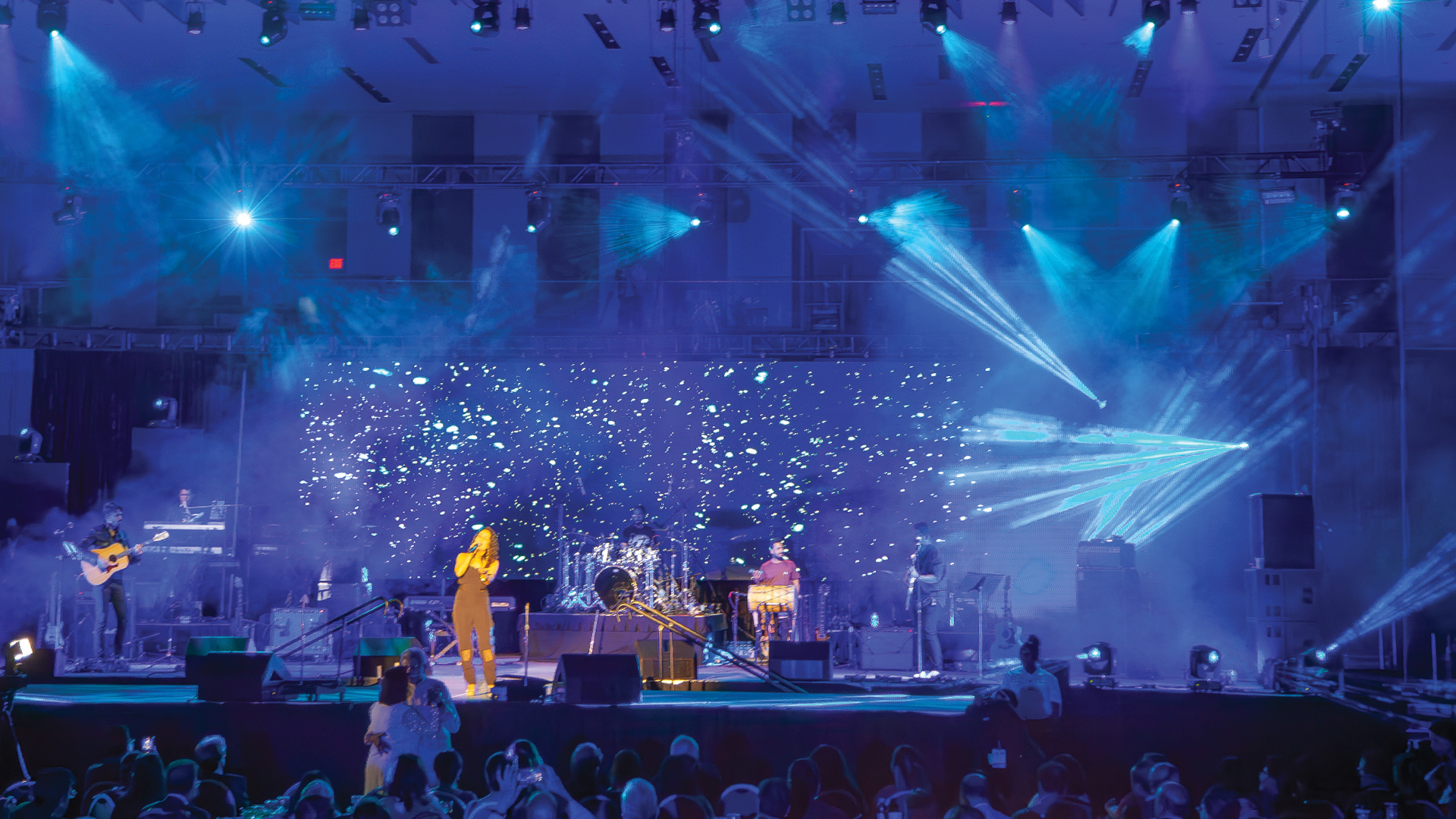
The ability of a professional PA system to perform consistently across 300 international arenas — spanning the acoustic variables of ancient Roman amphitheaters and ultra-modern purpose-built venues, the climate extremes of indoor climate-controlled arenas in Scandinavia and outdoor amphitheaters in the Australian summer, and the logistical complexities of operating across customs jurisdictions, electrical standards, and labor agreements in 60+ countries — is among the most demanding tests any technology can face. JBL Professional’s touring systems have faced this test not once but repeatedly, across multiple product generations and touring cycles that document a real-world reliability record that no laboratory certification can replicate.
The Infrastructure Behind Global Touring Consistency
A touring PA system’s consistency across international arenas is only partially a function of the hardware itself. The service and support infrastructure that JBL’s parent company Harman International maintains globally — factory-authorized service centers in 47 countries, with replacement component inventories maintained at regional distribution hubs in Los Angeles, London, Frankfurt, Tokyo, and Sydney — is what converts technical capability into operational reliability. When a JBL VTX V25-II element sustains damage during a transatlantic freight journey and arrives at a European arena with a compromised HF transducer, the ability to replace that component within four hours from a regional parts stock is what keeps the show on schedule. The global service infrastructure that enables this response is built from decades of investment — and it represents a competitive barrier that smaller or newer PA manufacturers cannot easily replicate.
Arena Acoustics: The Challenges That Define the System
The 300+ international arenas in which JBL touring systems have performed represent an acoustic diversity that would challenge any system designer. European arenas built in the 1960s and 70s — venues like Forest National in Brussels and the Hallenstadion in Zurich — feature concrete construction, circular or oval geometries, and reverberant surface areas that create reverberation times of 3 to 5 seconds at mid frequencies, requiring the touring PA to deliver sufficient gain before feedback while maintaining intelligibility in an acoustic environment that actively works against it. Purpose-built modern arenas like the Lanxess Arena in Cologne and Ziggo Dome in Amsterdam feature acoustic treatments optimized for live performance, with reverberation times that the JBL VTX system’s controlled dispersion patterns can work with efficiently. The system engineers who tour with JBL VTX systems develop venue-specific DSP settings — EQ curves, delay configurations, limiting profiles — that are stored in JBL HiQnet Performance Manager session files and recalled for each venue’s specific acoustic signature.
The 300-Arena Record: Documented Deployments
The 300-arena milestone for JBL touring systems is drawn from documented production histories across multiple major touring productions. Bruno Mars’ 24K Magic World Tour (2017-2018), which covered 213 dates across 5 continents and played 6 world regions of arenas, used a JBL VTX V25 system as the primary PA. Justin Bieber’s Purpose World Tour (2016) — at the time the highest-grossing tour of the year — deployed JBL VTX systems across its 158-date arena run, with production supplier Clair Global managing the system builds across North American and European legs. The Red Hot Chili Peppers’ Unlimited Love Tour (2022-2023), produced by longtime partners Rat Sound Systems, brought JBL VTX to arenas across North America, Europe, and South America in a configuration that system engineer Pete Keppler described at a post-tour industry session as the most sonically consistent version of the system he had deployed across a full touring cycle.
Voltage and Standards: The International Engineering Requirement
International arena touring with JBL VTX systems requires explicit engineering attention to the electrical infrastructure variance between countries and regions. North American arenas operate on 60 Hz, 120/208V or 120/240V systems; European venues operate on 50 Hz, 230V single-phase and 400V three-phase systems; Japanese arenas use a unique 50/60 Hz split at 100V. The Crown I-Tech HD amplifiers that power JBL VTX systems incorporate universal power supplies that accept inputs from 100V to 240V at 50 or 60 Hz, but the physical distribution infrastructure — PowerLock connectors, Cam-Lok connectors, 63A CEE plugs — varies by region and requires a touring power distribution contractor to carry region-appropriate interface hardware. Festool distribution systems and Motion Labs touring power distribution equipment dominate this specialist market.
Redundancy in the 300-Arena Context
When a touring PA system is deployed across 300 arenas on a 12-month world tour, the probability that some component will fail at some point approaches certainty. The engineering response to this mathematical reality is systematic redundancy: every critical signal processing component in the chain has a backup that can be brought online within minutes. JBL touring system riders typically specify a minimum of one complete backup HiQnet processing server, one backup Crown I-Tech amplifier per amplifier model in the system, and two backup VTX line array elements per side. The backup amplifier rack — a pre-configured rack containing one of every Crown amplifier model in the system, fully processed and ready to patch into the primary rack — has become standard on productions at this scale, representing an investment of approximately $80,000-$120,000 in equipment that the crew hopes never to touch.
The Sound Engineer’s Perspective: Working Across 300 Rooms
FOH engineers who tour with JBL VTX systems across international arena runs develop a relationship with the system’s sonic character that influences their mixing approach in ways that venue-by-venue system changes never could. The ability to build on a known system foundation — to understand exactly how the system responds to EQ changes, how its low-frequency extension interacts with different room modes, how its HF HLA waveguide behaves at different horizontal coverage angles — allows experienced engineers to make accurate predictive adjustments when encountering an unfamiliar acoustic space. Dave Rat, whose long-running relationship with Red Hot Chili Peppers has been documented extensively, has spoken about the importance of system familiarity across a full world tour in allowing him to focus creative energy on the mix itself rather than on the system’s behavior.
What 300 Arenas Teach: The Data Advantage
The most underappreciated benefit of JBL touring system deployments across 300 international arenas is the data it generates. Each system build, each SMAART measurement session, each venue-specific DSP adjustment produces a dataset that, aggregated across hundreds of deployments, provides a remarkably comprehensive picture of acoustic reality in the global arena stock. JBL Professional’s application engineering team works directly with production companies to collect and analyze this data, using it to drive product improvements and to build the venue-specific optimization guides that production companies increasingly consult when planning system designs for specific venues. The transition from individual engineering experience to systematically documented collective knowledge represents one of the most significant infrastructure investments in the professional audio industry.
