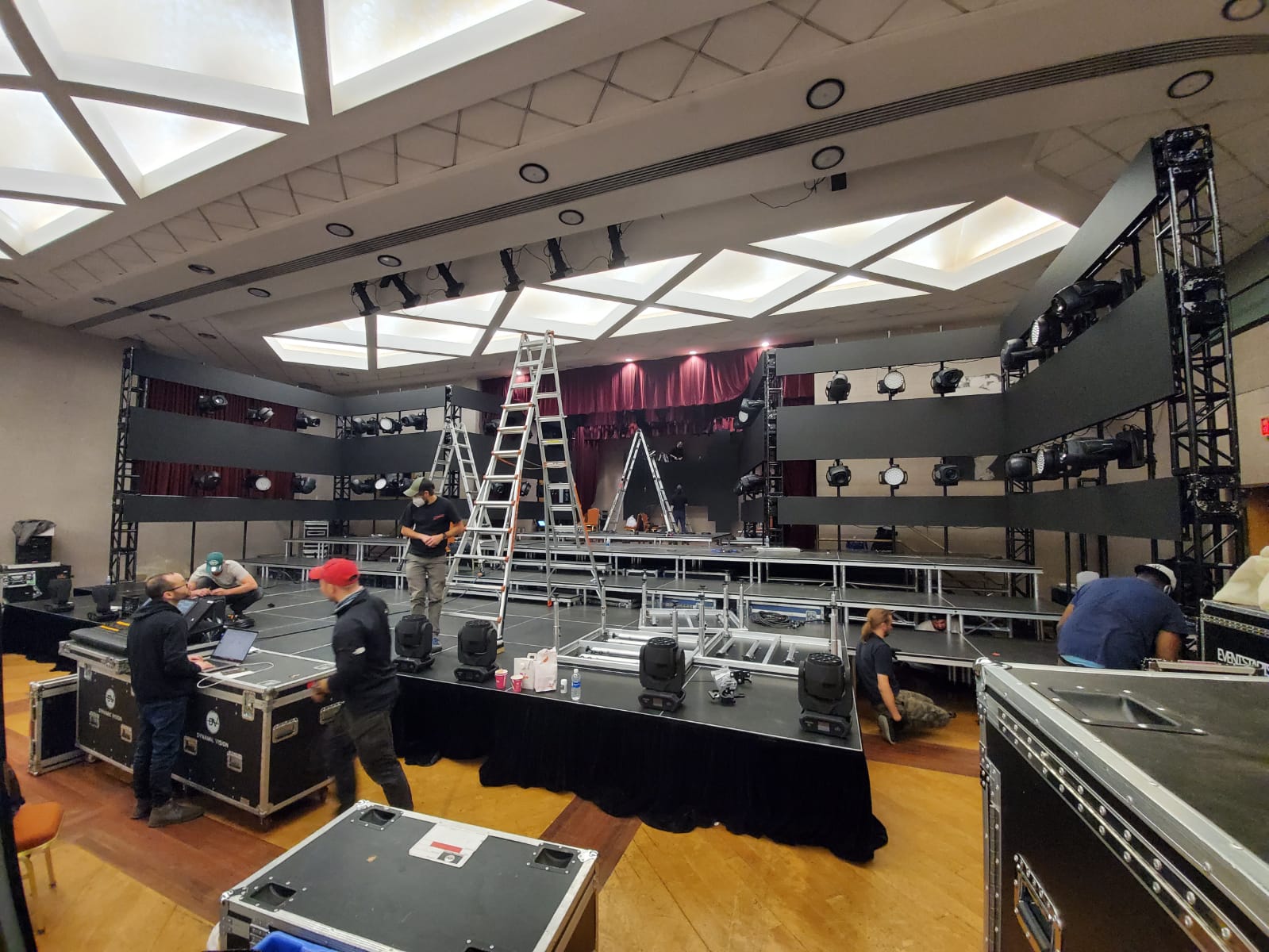
The collision between camera exposure requirements and LED wall brightness is one of the defining technical challenges of contemporary corporate event production. It exists because two fundamentally different priorities — spectacular visual design for a live audience and clean, professional imagery for camera output — are in direct physical conflict. The LED wall that makes the room look extraordinary is simultaneously attempting to destroy your video signal. Understanding why this conflict exists and how to navigate it separates production teams that deliver broadcast-quality event coverage from those that submit apology emails to the client with the video edit.
The Physics of the Problem
Modern fine-pitch LED panels — P2.6, P3, and P3.9 being the most common at corporate events — are extraordinarily bright devices. Panels specified at 1000+ nits are typical for indoor large-format applications; outdoor rental panels can exceed 5000 nits. Even at reduced drive levels, these surfaces emit more light than most camera sensor technology can accommodate simultaneously with a properly exposed human face. The human face at proper exposure typically requires an illuminance of 750–1500 lux at the sensor, while an LED wall in the same frame can be 50 to 100 times brighter than the ambient light level.
Camera sensors capture dynamic range — the ratio between the brightest and darkest elements in a scene that can be simultaneously recorded with detail. A modern Sony VENICE 2 or ARRI ALEXA Mini LF might capture 15+ stops of dynamic range. But in a live event environment shooting to a video recording or broadcast feed — not a cinema RAW format with latitude for color grading — the effective usable range is often 8–10 stops. A bright LED wall and a correctly exposed presenter face may require 12+ stops of dynamic range to coexist in the same frame without sacrificing one of them.
LED Refresh Rate and Camera Flicker: The Hidden Enemy
Beyond exposure challenges, LED panel refresh rate and camera shutter speed interaction creates a second, often undiagnosed failure mode: flicker. LED walls modulate their brightness using Pulse Width Modulation (PWM) — a rapid on/off switching cycle. When the camera’s shutter speed captures a different phase of this cycle in each frame, the result is visible horizontal banding or brightness fluctuation in the recorded image that is invisible to the human eye in the room but ruins the video output.
The solution requires either selecting high-refresh LED panels — quality production panels operate at 3840Hz or higher refresh rates, eliminating flicker at all practical camera shutter speeds — or carefully matching camera shutter speed to the LED processor’s output frequency. Most Brompton Technology Tessera and Novastar processors support selectable refresh rates from 1920Hz to 7680Hz. Communicate with your LED vendor and camera team before the event to establish a compatible refresh rate and shutter speed combination.
Practical Exposure Solutions
The most effective solutions operate on both sides of the exposure equation: reducing LED wall brightness and increasing presenter key light. The LED processor brightness control should be used to reduce the wall to the minimum level that satisfies the creative director’s intent for the room. For talent-proximate panels — sections of wall within 10 feet of the presenter position — further reductions are often possible without visible impact on the audience experience because the human visual system adapts to relative brightness differences.
On the lighting side, motivated key lighting at 2000–3000 lux on the talent’s face is typically sufficient to create a workable exposure ratio against even moderately bright LED walls. This level of illumination requires high-output fixtures — the Arri SkyPanel S360-C, Aputure LS 1200d Pro, or dedicated follow spots — positioned at appropriate angles to avoid spill onto the LED surface, which would wash out color accuracy on the wall itself.
Camera Placement and Lens Choice
Camera placement relative to the LED wall significantly affects the exposure challenge. Cameras positioned at acute angles to the wall surface pick up specular reflections of the wall’s own emission — amplifying the already-difficult exposure situation. Camera positions perpendicular to the wall or at angles greater than 45 degrees minimize this reflection artifact. Lens choice matters equally: wider apertures (lower f-stops) allow more light from the talent while the camera’s exposure control compensates for the wall — but this technique requires precise focus discipline, as shallow depth of field at f1.8 or f2 on a presenter who is moving laterally is an operator nightmare.
The Pre-Show Camera Test: Non-Negotiable
Every production involving cameras and LED backgrounds requires a dedicated camera test session before the show day. This means actual talent (or stand-ins) standing at all presenter positions, actual show content running on the LED wall, all lighting at show levels, and all cameras recording. Review the footage — not just the live monitor feed — because recording codec compression and broadcast encoding can introduce additional artifacts invisible on a live SDI feed. What passes a monitor check may fail a recorded review. The camera test is the moment to find and fix every combination of these variables before the client, the audience, and the pressure are all in the room simultaneously.
