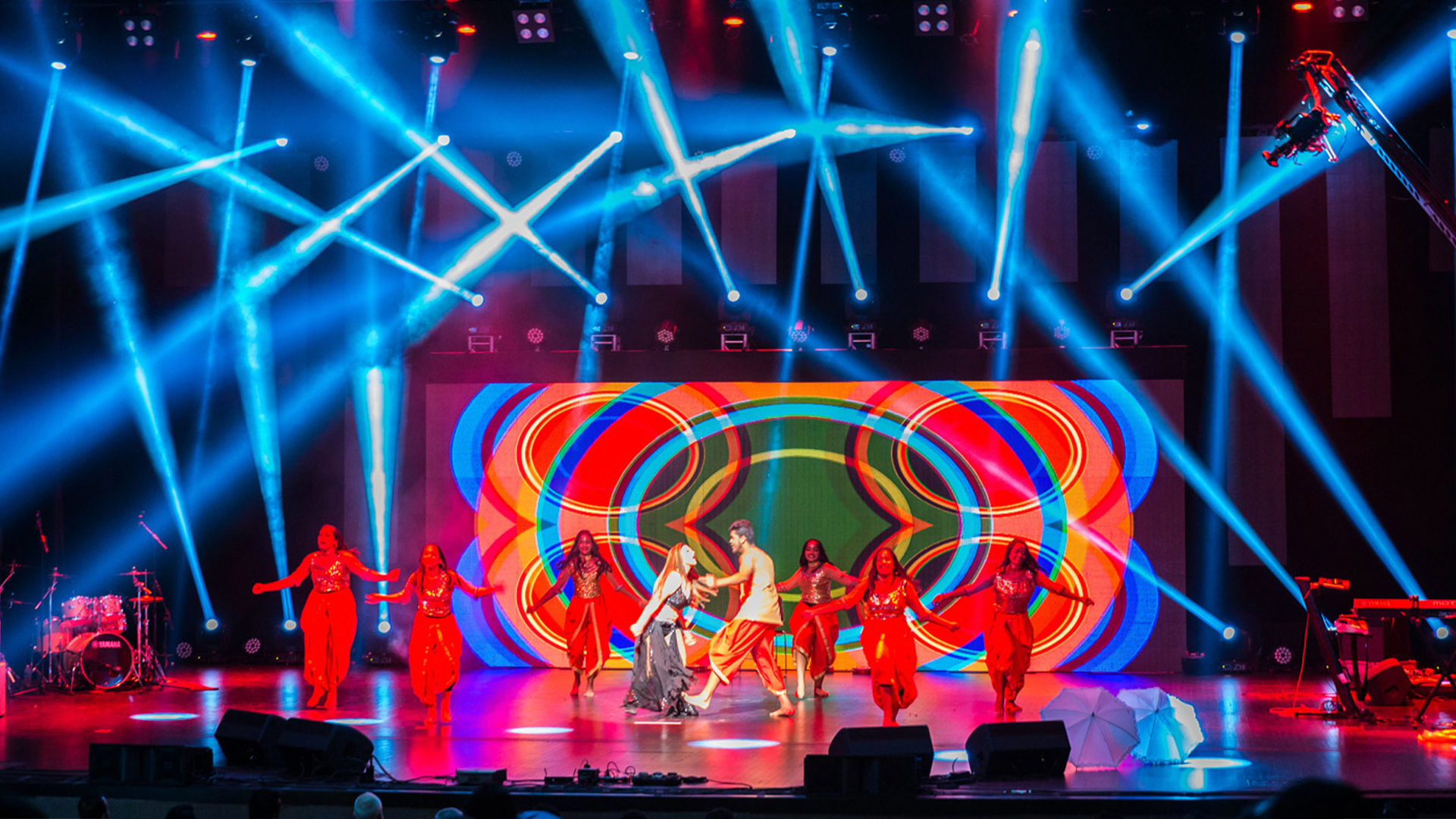
The LED panel revolution promised pixel-perfect displays rendering any image with mathematical precision. Millions of individually addressable light-emitting diodes arranged in matrices should produce exactly what content creators intended—faithful reproduction of source material without interpretation or editorialization. Yet these digital canvases occasionally decide to become artists themselves, creating optical illusions, moiré patterns, and visual phenomena that leave audiences questioning reality and video engineers questioning career choices.
The Physics of Unintended Visual Art
Understanding LED panel illusions requires appreciating the interaction between discrete pixel structures and human visual perception. Every LED display consists of individual emitters arranged in regular grids—the ROE Black Pearl BP2V2 spaces these at 2.8mm intervals, while the Absen A3 Pro achieves 2.97mm pitch. Human eyes integrate these discrete points into continuous images, but viewing angles, distances, and content characteristics can disrupt this integration, revealing the underlying pixel structure in unexpected ways.
The moiré effect—named after a type of watered silk fabric—occurs when regular patterns interact with other regular patterns at specific angles. Camera sensors photographing LED panels commonly produce moiré, but the effect also occurs in human vision when viewing distances position pixel pitch near the eye’s resolution limits. Fine patterns in content—clothing textures, architectural details, graphic elements—combine with panel pixel structure to create rainbow-like interference patterns not present in source material.
Refresh Rate Revelations
LED panels illuminate through rapid multiplexing—scanning through pixel rows or columns at rates intended to exceed human flicker perception. The refresh rate specifications of 3840Hz common in premium panels like the Unilumin UpadIII suggest rock-solid stability, yet interactions between refresh cycles, content frame rates, and viewing conditions create opportunities for visual artifacts. Peripheral vision proves more sensitive to flicker than central vision, meaning displays that appear stable when viewed directly seem to shimmer when glimpsed from the corner of the eye.
Camera systems exacerbate refresh-related artifacts dramatically. The rolling shutter sensors in most video cameras capture images line-by-line rather than simultaneously, creating interactions with LED multiplexing that produce horizontal banding invisible to human observers but prominent in recorded footage. Broadcast productions using Blackmagic URSA or Sony FX9 cameras must carefully match camera shutter angles to panel refresh timing—a coordination challenge that often reveals itself only during live broadcast when correction becomes impossible.
Color Science Complications
The color reproduction capabilities of LED panels depend on the spectral characteristics of their emitters—characteristics that differ between manufacturers, production batches, and even panels from identical batches. The Brompton Tessera processing applies sophisticated calibration to match panels, but fundamental spectral differences between LED types create metameric mismatches where colors appear identical under some lighting conditions and noticeably different under others.
Mixed panel inventories—common when rental companies combine stock from different purchases—create visible color discontinuities despite careful calibration. The color gamut achievable with one batch of panels may differ from another, creating situations where saturated colors reproduce accurately on some panels while appearing shifted on adjacent units. These color illusions prove particularly frustrating because they may appear only under specific content conditions—a logo in corporate colors that appears perfect in testing but wrong when displayed alongside show graphics.
The Mapping Maze
Pixel mapping—the correspondence between source content pixels and physical LED locations—introduces its own category of optical illusions. The NovaStar MCTRL4K and Colorlight Z6 processors handle complex mapping configurations, but errors in configuration files create spatial distortions that range from subtle to hallucinatory. A mapping error shifting columns by single pixels creates edge artifacts visible primarily in motion; mapping entire sections incorrectly produces content that appears to exist in non-Euclidean space.
Curved LED installations—now common in concert touring and virtual production stages—require mapping that accounts for panel orientation relative to viewing positions. The disguise media server platform handles these calculations through sophisticated projection models, but discrepancies between calculated and actual panel positions create content that appears to bulge, pinch, or warp in ways that convince viewers they’re witnessing intentional effects rather than configuration errors.
Historical Context: From Scoreboard to Stage
The evolution of LED display technology for entertainment began with stadium scoreboards where viewing distances minimized visible artifacts. The Daktronics displays dominating sports venues in the 1990s featured pixel pitches measured in centimeters—far too coarse for close viewing but perfectly adequate when observed from stadium seating. The transition to fine-pitch LED suitable for broadcast and theatrical applications introduced optical challenges that stadium applications never encountered.
The SMD (Surface Mount Device) LED technology enabling fine pitch displays packages red, green, and blue emitters in close proximity within single components. This integration improved pixel density while creating color uniformity challenges when viewing angles cause different-colored emitters within each package to appear with varying intensity. The ‘color shift’ visible on LED walls when viewers move position isn’t imagination—it’s optical physics demonstrating that LED colors exist in three-dimensional space rather than on flat surfaces.
Content Characteristics and Panel Interactions
Certain content characteristics trigger LED panel optical illusions more readily than others. Fine geometric patterns—grids, stripes, and regular textures—interact with pixel structures to create moiré regardless of display quality. High-contrast edges reveal processing artifacts that uniform content conceals. Rapid motion exposes response time variations between pixels, creating temporary color shifts or brightness variations during transitions.
The bit depth of signal paths affects gradient reproduction in ways that can appear illusory. 8-bit processing—256 levels per color channel—proves inadequate for smooth gradients on displays with 14-bit or higher internal processing. The banding artifacts in gradient transitions create stepping patterns that viewers might interpret as intentional design elements or display defects depending on context. A sunset background intended as smooth color transition becomes series of visible bands that attract attention rather than providing ambient atmosphere.
Virtual Production: Where Illusions Become Essential
The emergence of virtual production using LED volumes creates scenarios where optical illusions transition from problems to features. Stages using ROE Black Pearl or Sony Crystal LED panels must create convincing backgrounds that cameras perceive as real environments. The Unreal Engine content driving these displays incorporates deliberate perspective corrections that would appear distorted to human observers but create proper parallax for camera lenses positioned at specific locations.
This intentional manipulation of perspective creates fascinating scenarios where the ‘correct’ image exists only from camera viewpoint—human observers standing on virtual production stages see deliberately warped content that the camera interprets as spatially accurate. The illusion that serves one viewer confuses another, demonstrating that LED panels don’t create illusions independently but participate in complex perceptual systems where viewer position determines which version of ‘reality’ appears correct.
Managing the Inevitable
Experienced video engineers develop strategies for minimizing unwanted optical effects while accepting that some phenomena prove unavoidable. Content review processes flag patterns likely to create moiré, enabling modification before production. Camera angle planning positions lenses to minimize rolling shutter artifacts. Shutter angle coordination between cameras and LED refresh systems reduces banding visibility in recorded footage.
The Brompton Tessera software includes ShutterSync functionality specifically addressing camera-LED interactions, while NovaStar and Colorlight processors offer similar features. These tools mitigate rather than eliminate optical artifacts—the physics underlying LED display operation guarantee that some visual phenomena will always emerge under specific viewing conditions. The professional approach acknowledges this reality while implementing every available mitigation.
Embracing the Digital Canvas
LED panels that create optical illusions remind us that these displays aren’t passive windows but active participants in visual perception. The interactions between discrete pixel structures, refresh timing, color science, and human visual processing create a complex system where unexpected phenomena emerge naturally. Some productions leverage these characteristics creatively—moiré patterns become design elements, color shifts create dimensional effects, and the ‘flaws’ of LED technology transform into artistic features.
The continuing evolution of LED technology—finer pitches, higher refresh rates, improved color science—reduces but never eliminates optical illusion potential. Each technological generation introduces new characteristics alongside improvements, maintaining the dynamic relationship between display capability and human perception. The LED panels creating optical illusions for fun aren’t malfunctioning—they’re demonstrating the fascinating complexity inherent in converting digital signals into visual experience, one pixel at a time.
